
by Swati Maddi and Shivam Garg
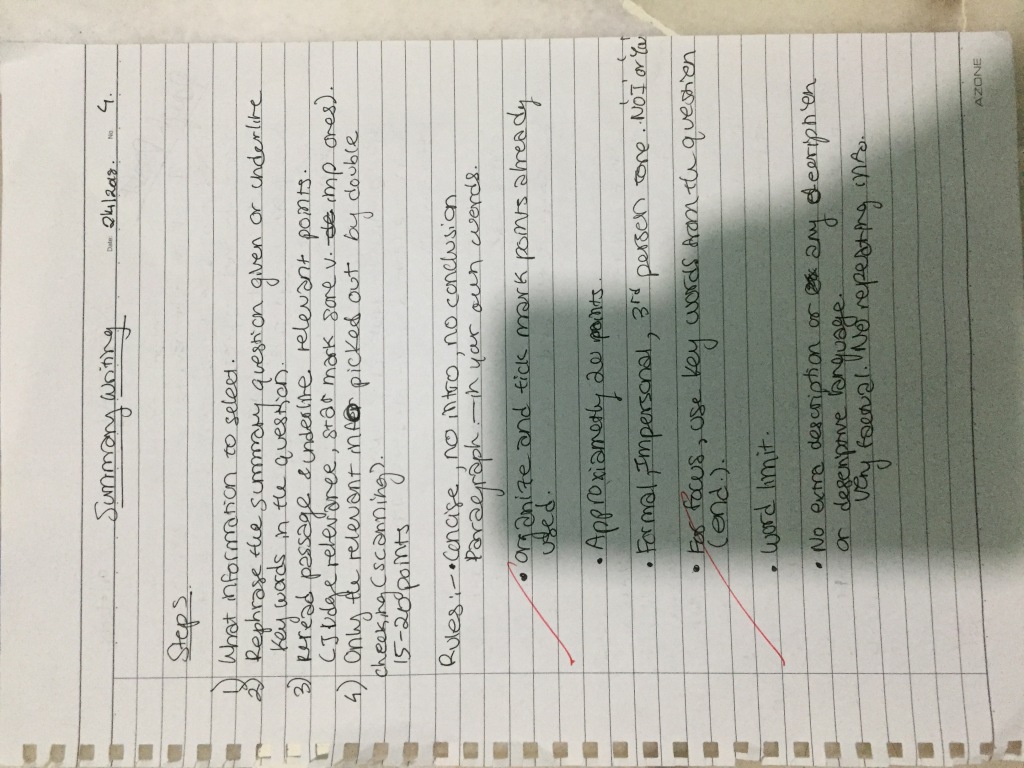
Step-1 –> Read the question and title first to get a rough idea of what is going to be discussed.
Step 2 –> While reading for the first time quickly go through it to get a rough idea of what you are dealing with. Then, once you have a firm understanding of the topic, identify relevant points by either underlining or circling (or anything that suits you, but make sure you leave a physical marker as it greatly aids while you are writing).
Step 3 –> Upon identification of the point, try grouping related points. For instance, if the question is “Downsides of Car Loans” and there are few points regarding monetary disadvantages, societal disadvantages, psychological disadvantages (for the sake of an example). Then, group together these points (for instance, all points related to monetary downsides will fall in one group). There is great benefits in doing so and it greatly helps in saving time while writing, as in one sentence you can write like ” it has several monetary disadvantages such as *point 1* , *point 2*, *point 3*….” Also, while grouping the points (on the passage) just create a sort of a key/legend (like on a map or you can use highlighters to color code the groups) so that you know which point is under which group so that you don’t have to constantly stop (to look for points) while writing. So for instance, near every point covering monetary disadvantage you can put a short form “M” or “MD” (or anything that you deem fit)
Step 4 –> Finally, start writing. Although writing an introduction or conclusion is not necessary, you can always give a brief introduction but with some points in it so that it doesnt seem abrupt. So for instance, the first point you want to write is “Car loans have grave economic impacts on the borrower” . Instead of starting (the summary) straight away with “Car loans have grave economic impacts on the borrower” you can just add a few words in the beginning to make it sound more smooth. For Instance, you can state “Car Loans, although beneficial sometimes, can have grave economical consequences on the borrower” . This not only allows you to get straight into your answer but also allows you for a smoother opening allowing you to get a few extra points (with the mere addition of 3 words). But, do note that the “benefical” aspect (or the words you are using to allow for a smoother opening) must at least be discussed to some extent in the passage.
Step 5 –> Keep in mind that you write the entire answer in one paragraph, so when I state introduction and conclusion I mean the first or the last line of the only paragraph in your essay. In the body part, combine the points of one group (monetary disadvantage) and write it in one sentence (with each point separated by the comma). Trust me, it makes a big difference. It allows you to easily compress your answer. Using this technique I was able to condense my answers from 1 entire page (which is above word limit) to around 12-18 lines on my actual board paper.
Step 6- Finally, in the conclusion, like in the introduction, try not to make it abrupt. Make sure you end it well as that is the final thing the examiner remembers about your answer. Although that doesn’t mean you can start etching down your rhetorical flourishes using superfluous language, you can use a few words/simple sentence to give your answer a good ending. Trust me, It makes a big difference.
Hope you found this helpful,
Happy studying!
 prepIGCSE