IGCSE Business Tips/Command Terms

Business Tips by Aditi Prasad

Using the reasource insert in the exam

  • Read the title, key, axes of graphs, etc. to find out exactly what it is showing you. 
  • Look for dates, scale, and location. 
  • Try using coloured pencils or pens to pick out anything that the question asks you about.

Plan your answers. Think about what you want to say. Clear, concise, well-ordered, well-argued, well-supported answers get more marks than long, rambling, muddled, repetitious answers. Quality is better than quantity.

Mark allocation and answering the question – Paper 1

  • 2 MARKS – Clear understanding, clean cut exact definition
  • 2 MARK – Application [2 × 1]: award 1 mark per advantage/identification
  • 4 MARKS – Knowledge [2 × 1]: award 1 mark for each reason identified Application [2 × 1]: award 1 mark for each explanation in context 
  • 6 MARKS – 
    • Knowledge [2 × 1]: award 1 mark for each relevant factor. 
    • Application [2 × 1]: award 1 mark if relevant reference made to given business
    • Analysis [2 × 1]: award 1 mark for each relevant explanation. 
  • Do you agree? Justify your answer – 6 MARKS
    • Knowledge [1] : award 1 mark for identification of relevant point (s) 
    • Application [1] : award 1 mark if relevant reference made to this business 
    • Analysis [2]: award up to 2 marks for relevant development of point(s) 
    • Evaluation [2]: justified decision. Either viewpoint is fine.

Mark allocation and answering the question – Paper 2 

  • Identify and explain two advantages and two disadvantages.. – 8 MARKS
    • Advantages – 2
    • Disadvantage – 2
    • Explanation – 4
  • Consider the advantages and disadvantages of the following two options…. Recommend the option business should choose. Justify your answer. – 12 MARKS
    • Advantage – 2
    • Disadvantage – 2 
    • Explanation – 4
    • Recommendation – 2 
    • Application – 2
  • Identify and explain – 8 MARKS
    • Knowledge – 2  
    • Analysis – 2 – relevant explanation 
    • Application- 4 application marks
  • Consider the following three ways… Recommend the best way to choose. Justify your answer.  – 12 MARKS
    • Advantage – 3 marks
    • Disadvantage – 3 marks  
    • Application – 3 marks
    • Reccomendation/explanation – 3 marks
  • Refer to Appendix 3 and other information in the case study. Consider the financial performance of TT. Do you think the directors should be pleased with the company’s performance? Justify your answer using appropriate ratios.  – 12 MARKS
    • Return on Capital Employed :
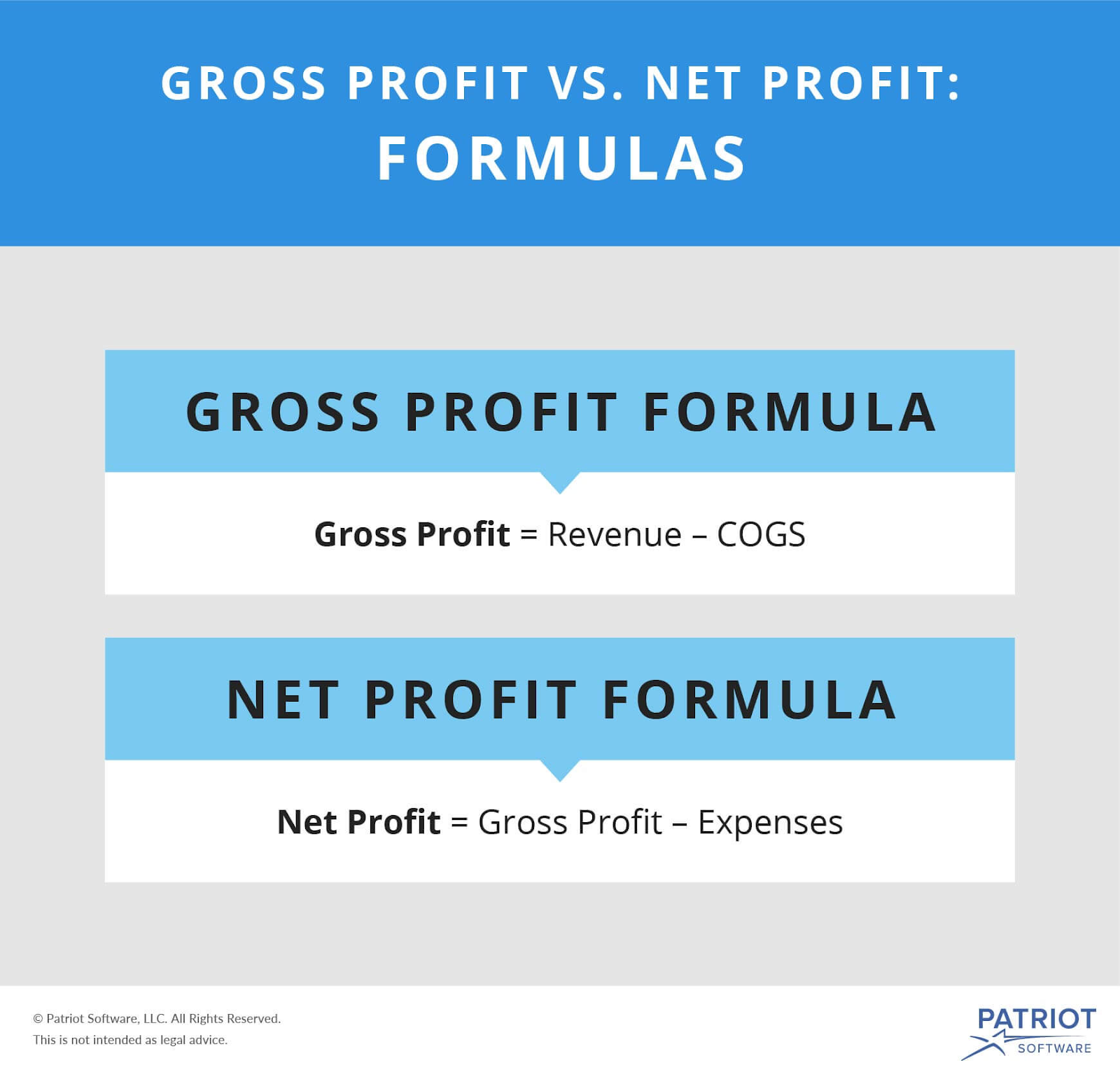
  • Net Profit and Gross Profit :

Divide this by the revenue total to get percentage net profit and gross profit percentage

IGCSE Global Perspective Complete Guide

TYPES OF GP QUESTIONS by Aditi Prasad

Q1. Always Source 1 and 2

a)    IDENTIFY TRENDS – Carefully read the information in the INSERT

b)    IDENTIFY CAUSE OR EVALUATE TRENDS CHANGE – Carefully analyse  

c)    REASON FOR b) – evaluate this – WHO, WHY, HOW

d)    EXPLAIN PERSPECTIVE (Global, local, national) – Constantly refer back to the question: Give environmental, economic, social, cultural, political views

Q2. Always Source 3

a) “How well does the author use evidence to support the claim that…”  

ð  Authors view + his tone – 

  • Emotionally charged, 
  • serious, 
  • assured, knowledgeable

ð  How he supports it

  • KNOWLEDGE CLAIMS 

o   Stats?

o   Fact?

o   Anecdote?

o   Published studies?

ð How he could improve it + the weakness in his argument

§  research evidence is partially cited – the date, title, author and source are not fully clear

§  level of expertise of the author is not clear and only asserted – may have poor knowledge claims in practice

§  method of research of source/citation is unclear

§  there is no clear, specific statistical/numerical evidence

§  the evidence is not easy to verify/check from the information provided

§  too much reliance on opinion

§  evidence may be out of date

§  personal testimony/anecdote/values may not apply to other places/ countries etc.

§  the evidence may be presented in a biased way (self interest)

§  use of examples is anecdotal

§  language used to support evidence is exaggerated

Format:

Quality of claim- Fact, opinion, value judgement + claim

Tone 

Quality of evidence- Statistical, anecdotal(generalised? Recent?)

Weakness of arugement 

Vested interest/bias?

Practicality/acceptability

  1. Local
  2. National
  3. Global

Evaluate whether I feel compelled to agree with them – A convincing overall assessment or conclusion.

b) “How could you test this claim? You may consider the types of information, sources of evidence or methods you might use.”

=> Evaluate the types of information:

-Possible types of information:

1.     compare statistics/information past and present

2.    data from experts in the field  

3.    individual testimony or personal experience  

4.    material from international organisations and pressure groups

=> Evaluate source of information:

-Possible sources of information:

o   national and local governments and their departments

o   international organisations, e.g. United Nations; UNESCO

o   experts

o   research reports

o   pressure groups, charities and NGOs

o   media and world wide web

=> Suggest Possible methods:

o   review of secondary sources/literature/research/documents

o   interview relevant experts and professionals

o   internet search

o   questionnaires

o   surveys

AT LEAST 3 DEVELOPED POINTS. IN CONCLUSION OF ANSWER DISCUSS HOW THE EVALUATION ALLOWS US TO VERIFY OR VALIDATE THE CLAIM.

c) “How effective do you think this method is?”

Evaluative points:

• some evidence can be provided – opinion, values

• the evidence will come from appropriate subjects/target

• will only get responses from a small segmented of those affected(SURVEY)

• method of research is time consuming and labour intensive

• there will probably be little clear, specific statistical/numerical evidence

• too much reliance on opinion

• evidence takes a long time to collect and analyse

•(In case of public interest) The response is to clearly and explicitly be related to collecting public opinion.

Format:

  • What is the method
  • Why is helps to gain info
  • Why it does not help to gain the info
  • Time?
  • Cost?
  • Other concerns

Clearly reasoned, credible and structured explanation of the effectiveness of the method. Must contain two (or more) developed points, and may contain some undeveloped points.

d)      “How could you persuade people in..”

FORMAT-

• who you need to persuade and why – Straightforward; “I would convince… as they are most affected by it”

• what you need to tell them- 

  1. Sense of urgency by amplifying the issue with certainty – statistical data and pictures.
  2. They have the power to do something about it 
  3. reasons for the need for change
    1. Quantitative and Qualitative relations between the issues
    2. Show impact- WHOM AND WHY

• the method(s) you would use – advertising, interviews, posters, campaign, workshop, etc.

Q3. Source 

A)IDENTIFY- Carefully from the case study

b)    EXPLAIN –identification from case study

c)    IDENTIFY A CERTAIN TYPE OF ARGUMENT:

  1. Fact- a verifiable piece of information
  2. Opinion- a view or judgement formed about something, not necessarily based on fact or knowledge
  3. Value judgementassessment of the rightness or wrongness of something // defined as a view or belief about what is important/ethical/moral/right or wrong.
  4. Claim- an assertion that something is true, can be based on facts or cannot be based off facts
  5. Prediction- attempts to forsee or say what will happen in the future

d)    “Which argument is more convincing?  Your answer should consider both arguments, and you should support your point of view with their words.

You should also consider:

• the strength of their reasoning and evidence

• their use of language

• different types of information.”

ð  Person 1

o   Strength of reasoning:

• logic

• structure

• balance

• claims

o   Use of language:

• tone – emotive, exaggerated; precise

• clarity

o   Evidence:

• range of information and depth

• relevance

• sufficiency – sample

• source – media; internet

• date – how recent

• different types of information – fact, opinion, value, anecdote

• testimony – from experience and expert

o   Sources of bias:

• local interest

• economic

• personal values

o   Acceptability of their values to others:

• how likely other people are to agree with their perspective/view

• likely consequences of the ideas presented

REPEAT WITH PERSON 2’S ARGUMENT AND COMPARE WHICH IS STRONGER AND WHY AS THE CONCLUSION.

Q4. Source 1-4

a)    “Recommend a certain decision with why…

  • state your recommendation
  • give reasons to support your choice
  • use the material in the Sources and/or any of your own ideas
  • consider different arguments and perspectives.”

Are expecting to use and develop the material found in Sources 1–4, but should go beyond simply repeating or recycling without adaptation. Other material may be introduced but it is not necessary to gain full marks.

Format:

  1. State the Choice Picked/ Opinion – 1
  2. Advantages- why it fulfils goal-3
    1. environmental, 
    2. economic, 
    3. social, 
    4. cultural
  3. Disadvantages of other options- why Effect on whom and why is it not benefiting to them – 3
  4. Gloss overr disadvantages of picked decisions but follow with – “nonetheless this outweighs the aforementioned advantages given above”
  5. Local Effect Overall -2
  6. National Effect Overall – 2
  7. Global Effect Overall – 2
  8. Cultural Effect – barriers? – 2
  9. Consequences of the decision being made:
    1. Potential conflicts – 4
      1. Taxpayers and Citizens
      2. Home country business
      3. Government
      4. Outer world
    2. Influence on important stakeholders – 1
  10. Compared to other decisions:
    1. Cost – 2
    2. Time – 2
  11. Leading to a conclusion of finally why it is the best solution. – 1 (How advantages overlap the disadvantages/or better results long term/short term/or why more effective then other methods)

24 Marks total – four (or more) developed points, and some undeveloped points

IGCSE Biology Notes on Human Influences on Ecosystem

 Bio notes

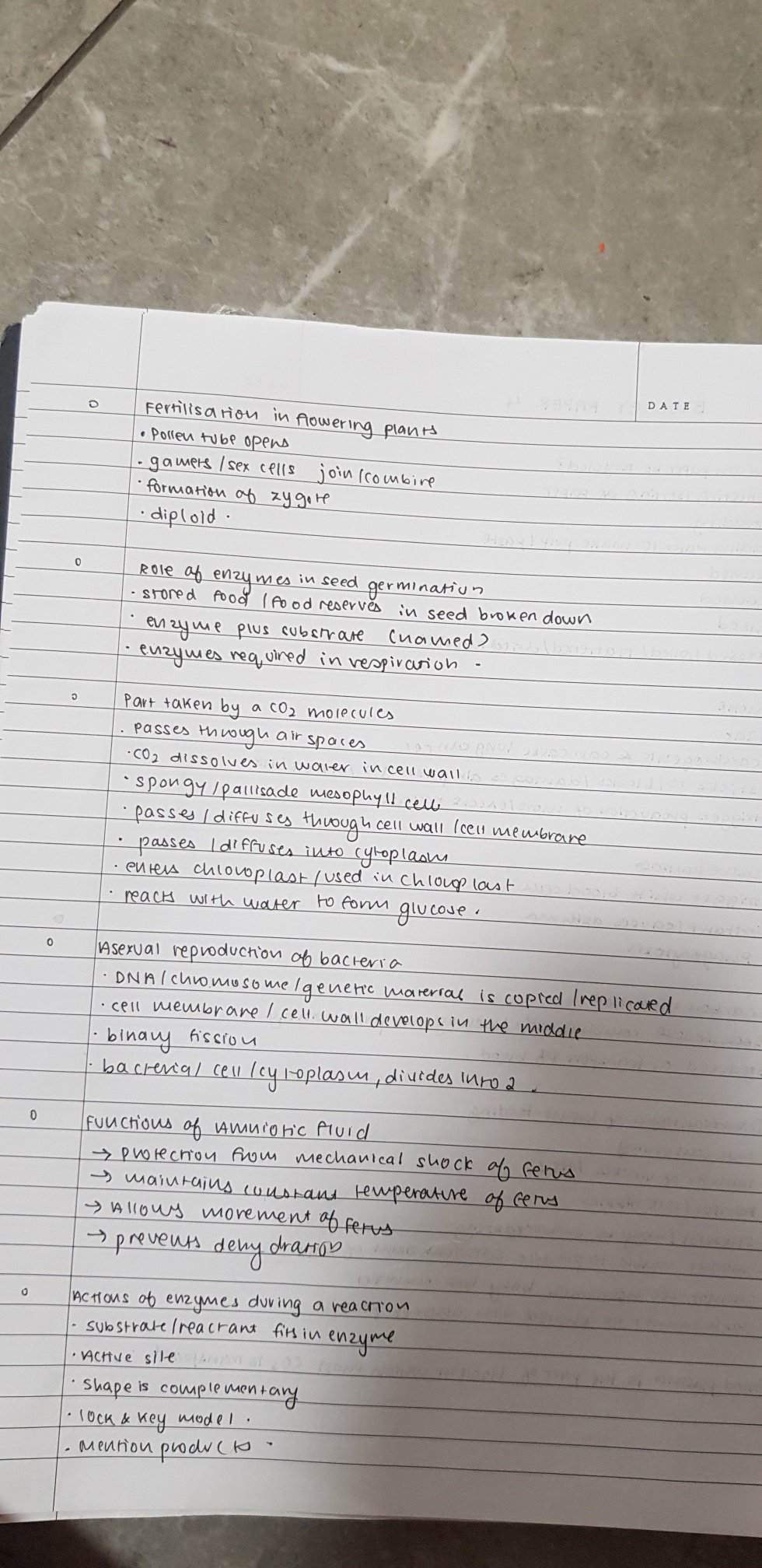
  • Impact of intensive livestock production
  •   Rearing of calves and chickens on a large scale production is called factory farming. They are reared in large sheds instead of open fields and their urine and faeces are washed off leading to the formation of a slurry which if it finds its way to rivers and streams can lead to eutrophication. 
  • If the animals are kept on a pasture, it can lead to overgrazing where the animals can eat the grass down to the roots and their hooves can trample the surface into a hard layer. This prevents the penetration of rainwater resulting in soil erosion. 
  • Factors that contribute to famine
  • Climate change and natural disasters such as excessive rainfall which can cause the soil to be water logged and infertile 
  • Pollution 
  • Water shortage because of it being used for other purposes like building dams and diversion of rivers. 
  • Seed shortage 
  • Poor soil due to lack of inorganic ions and fertilisers
  • Desertification due to soil erosion 
  • Economic implications of famine 
  1. Detrimental effect on country’s economy 
  2. Countries with large debts export cash crops even though the local people need it. 

Buffer- A solution that resists a change in pH (chemistry)

Food supply

  • Intensification of agriculture
  • Machinery 
  • Pesticides
  • Fertilisers
  • Selective breeding 
  1. Mono cultures
  2. Factory Farming 
  3. Famine 

Habitat Destruction 

  • Reason for habitat destruction 
  • Increased area for food crop growth ;Livestock production and growth :

 Large areas of land are cleared to provide space for growing food crops in order to meet the increased demand of food. This results in the loss of habitat in a wide variety of plants and animals, however, farmers can be educated about techniques of land management which include leaving strips of uncultivated land between the fields and around its margins. Eg: The Farming and Wildlife Advisory Group(FWAG) is an institution which educates farmers on these cultivation techniques. 

  • Extraction of Natural resources:

The extraction of fossil fuels causes damage to habitats. The dumping of rocks and soil in big heaps also prevents the process of redevelopment. It also results in scraping of soil from the surface of the land. Oil spills are also toxic and can destroy habitats when the oil seeps into the soil and water systems. 

  • Marine pollution:

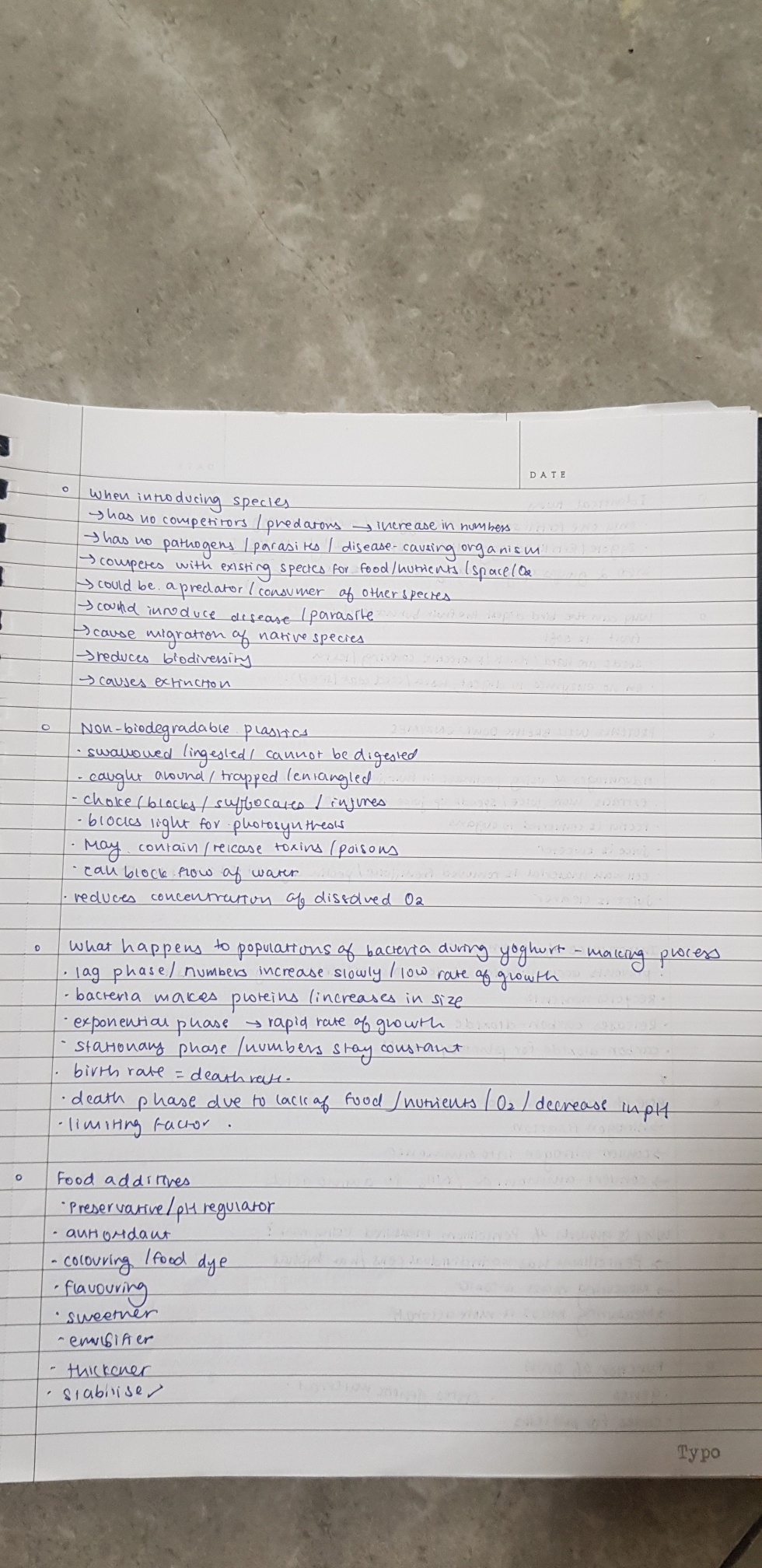
Aquatic systems can be polluted with human debris that include, untreated sewage, agricultural fertilisers and pesticides. Artificial fertilisers create a dead zone where there is no oxygen due to eutrophication.  Oil spills can also kill seaweeds which provide nutrients to aquatic life. Plastics are non-bio degradable and hence persist in the environment for a very long time. They are also often mistaken for food by marine organisms causing sickness. 

Any form of Habitat destruction, even if it wipes out a single species, can have signaficant negative impact on food chians and food webs.

  • Deforestation as a method of Habitat Destruction 
  • Deforestation is the removal of large number of trees. 
  • Significance of forests: oxygen, food resources, habitat(home)(known as biodiversity”hot spots” eg. Approx. 5 million different species are present in the tropical rainforests), climate control(environmental buffers), , soil maintenance(roots of trees hold the soil and prevent soil erosion), water supply
  • Why does Deforestation occur?
  1. To provide for timber
  2. For firewood
  3. For agriculture, roads and settlements. 
  • Impacts of deforestation 
  1. Loss of habitats 
  2. Increase in soil erosion 
  3. Increase in soil erosion because there are no roots to hold soil in place. The soil can be washed into rivers and lakes which also destroys the habitats there and can also result in floods. 
  4. Carbon dioxide levels increase in the atmosphere leading to global warming. 
  5. There are other climate change the result in habitat destruction. 

Climate Control:

  • Environmental Buffers
  1. Transpiration leads to rainfall 
  2. Clouds don’t reflect the sunlight and hence keep the region cool
  3. Reduce levels of carbon dioxide since increased carbon dioxide levels results in global warming as it is a greenhouse gas.

Pollution 

  • The presence in or introduction into the environment of a substance which has harmful or poisonous effects. 
  • There are three types: Land, Air, Water 
  1. Land and Water:
  • Insecticides and Herbicides:

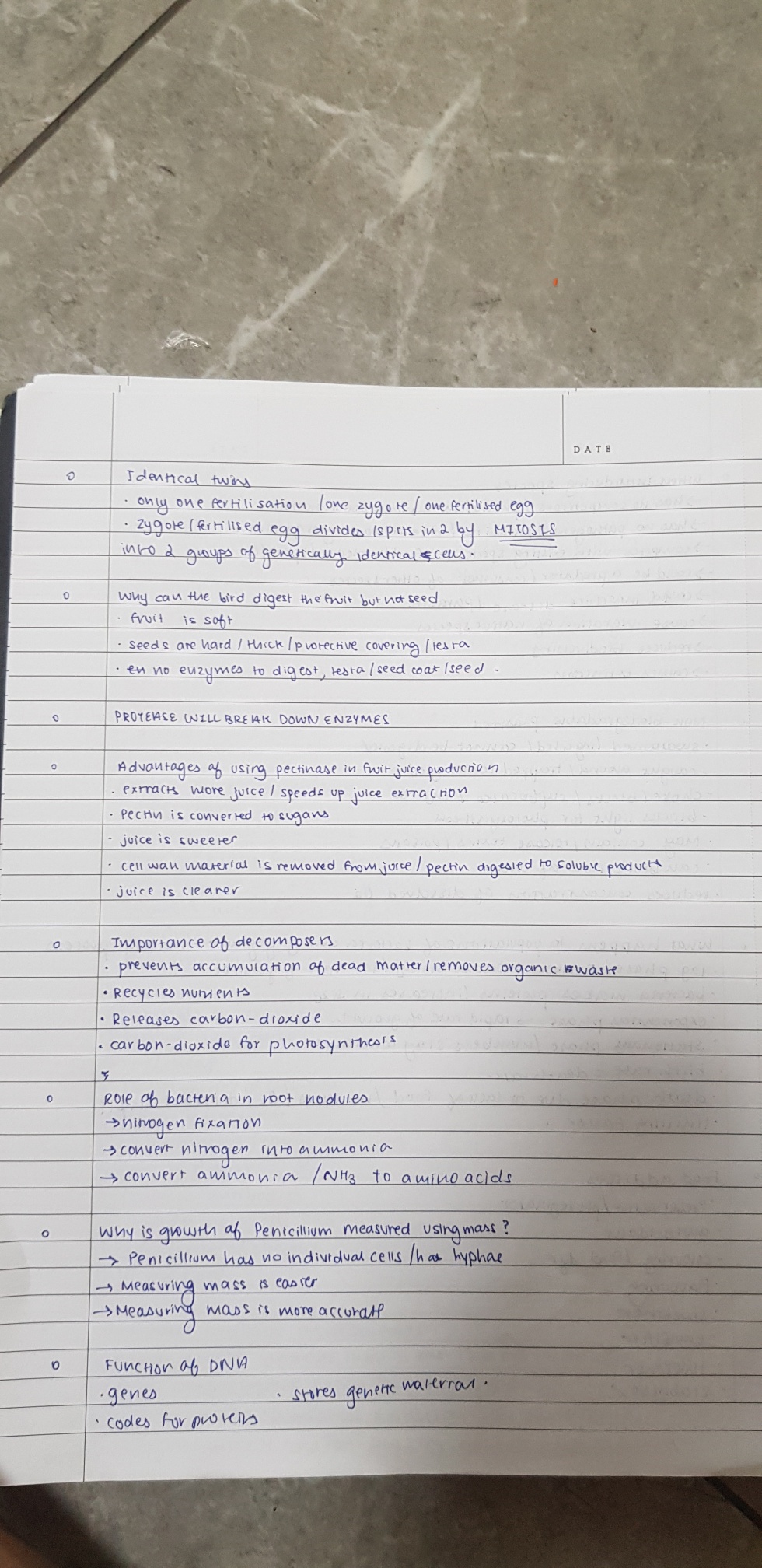
They are washed off from farms or there can be accidental leakage into water bodies. If they are persistent(they cannot be broken down)pollutants(herbicides and insecticides, they can enter the food chain. Bioaccumulation takes place as they get accumulated along the food chain. Herbicides can even even destroy the plants in water bodies, thereby removing the producers from the food chain. Eg: Bioaccumulation of DDT- when the DDT was sprayed to kill the beetle that were spreading the Dutch El disease. The fallen leaves which were contaminated with DDT were eaten by earthworms. The earthworms were eaten by the birds. Where concentrations reached lethal proportions, killing 30-90% of the birds. This also caused them to lay eggs with soft shells which broke easily and resulted in fewer chickens being hatched

  • Nuclear fallout: 

This can occur due to a leakage from a nuclear power plant or from a nuclear explosion. The radioactive particles are carried by wind and water and settle in the environment or absorbed by organisms. If they have a long half life there can be bioaccumulation in food chains, leading to cancer in the top carnivores. Nuclear accident @Chernobyl led to death led to the death toll of 4000 with many suffering from birth defects and cancer. If the particles read the water bodies, the fish also become unfit for consumption. 

  • Chemical waste, discarded rubbish, untreated sewage and fertilisers:
  • Chemical Waste

This is the waste released from industries. These can be poisonous such as copper and cyanide, released from the electroplating industry. If released in water, it can kill animals, plants and humans if they drink this water. Eg: Hg released in water bodies and was concentrated as it passed along the food chain; causing brain damage and deformities and death in people who consumed the fish. 

  • Discarded rubbish

Due to the increasing population , waste disposal is a problem. Landfill sites are used for depositing wastes; this plates the ground and attracts insects. If deposited in water it can cause severe problems in aquatic animals. 

  • Untreated sewage 

If untreated sewage is let off it can spread many diseases or pathogens can be present in the faeces of diseased people. 

  • Fertilisers 

Causes eutrophication(algae grow)

Eutrophication: 

Fertilisers (N, P ) run off into water bodies. 

    |

    |———>  They cause an algal growth(large increase in the number of algae due to excessive nutrients being washed of into water bodies)

                            |

                            |

                            |———>  Prevents the penetration of sunlight 

                             |

                             |

                                                                    |————-> Results in the death of plants present in lower layers 

                                                   |

                                                   |

                                                                                                                       |———-> the dead plants are decomposed by bacteria(uses up all the oxygen for their respiration)

  • Plastics 

They are non-biodegradable an can not be broken down by decomposers. they remain in the environment, taking up valuable space and causing visual pollution. In water, plastics can trap small animals and when burnt, plastics release toxic gases. 

  1. Air Pollution: 
  • Factories and motor vehicles release smoke, oxides of sulphur and nitrogen, lead compounds and carbon monoxide and dioxide 
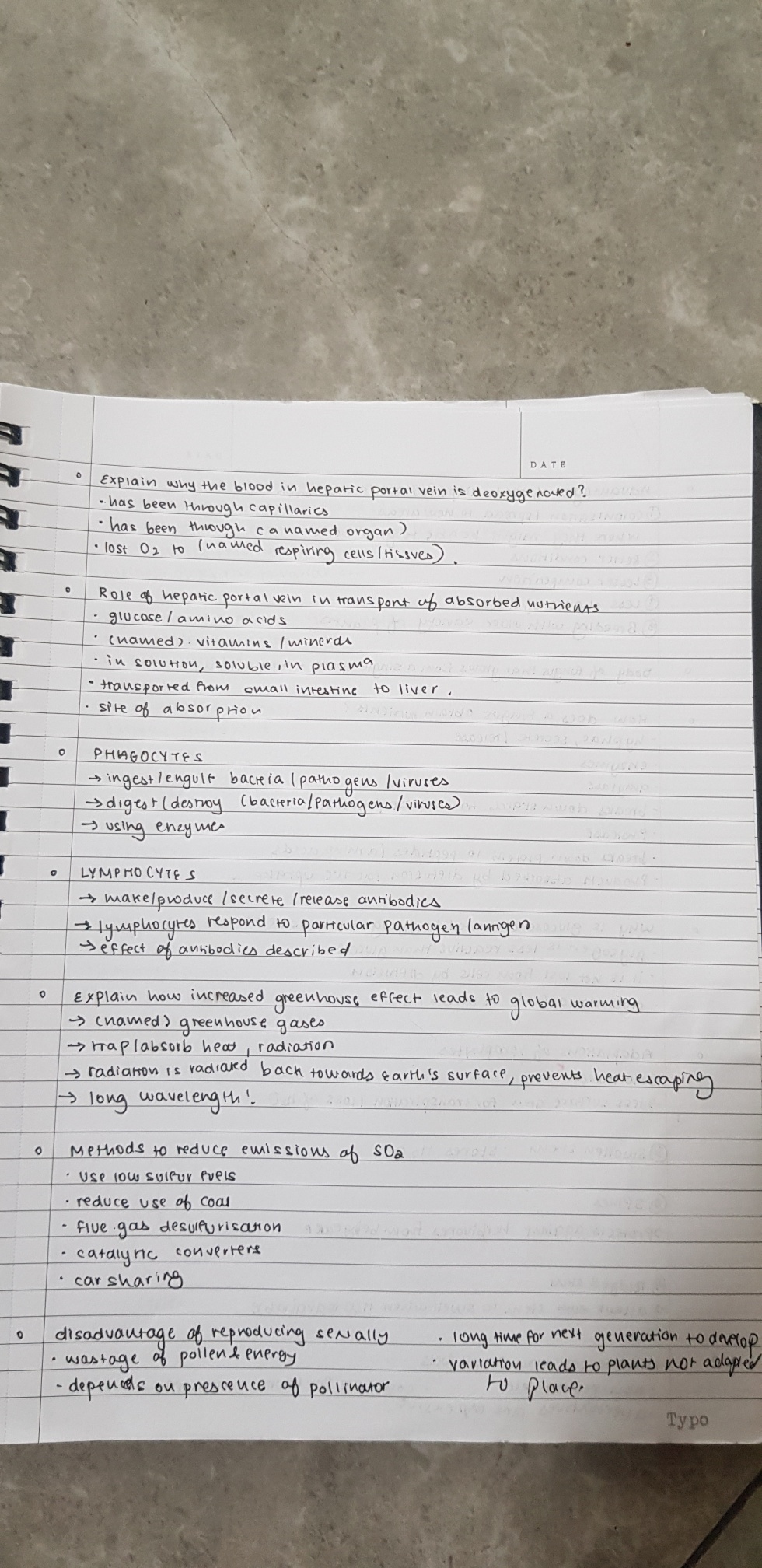
  • Oxides of Sulphur: they dissolve in rain water and fall as acid rain. This acid rain when it falls on plants, it can damage their leaves and hence reduce their growth. On buildings, it can dissolve the limestone and mortar. 
  • Oxides of Nitrogen: they dissolve in rain water and falls as acid rain. This dissolves the aluminium salts in the soil which reach the water bodies in toxic levels. These can also react in the atmosphere to produce ozone which can damage trees. 
  • Measures taken to reduce SO2 and NO2 pollution and reduce the impact of acid rain: 
  1. Fitting desulphurisation plans in power stations
  2. Changing the way to burn fuel(from coal fired to gas powered fire stations)
  3. Flue gases can be treated to remove the oxides of nitrogen
  4. Vehicles to be fitted with catalytic converters in their exhaust systems, this removes NO2, CO2 and unburnt hydrocarbons. Even though this increases the most of cars and can be only used with unleaded petrol.
  5. Redesign cars to burn petrol at lower temperatures(lean burn), this results in the emission of less NO2
  • Pollution of Air by methane and Carbon dioxide 
  • Sources: Burning of fossil fuels 
  • Impact : Enhanced green house effect and climate change 
  • Natural Greenhouse effect:
  1. Heat radiates from the Earth. Some of the heat goes to space and the atmosphere traps some heat 
  2. Quite a lot of heat is trapped and the earth is warm enough for life 
  3. Increase in cloud cover, reducing the heat reaching the earth from the sun 
  • Enhanced Greenhouse Effect:
  1. Atmosphere has more Greenhouse gases
  2. Heat radiates from the earth. Less of the heat goes to space and the atmosphere traps most of the heat 
  3. More heat is trapped and causes global warming 
  4. Changes in climate and rainfall distribution 

Negative Impacts of Contraceptives:

  • Sources: a)used in contraceptive pills, excreted in urine, present in sewage as cannot be removed in the sewage treatment b) Natural hormones of cattle present in their urine and can be washed off from farms 
  • This reaches water systems 
  1. In male frogs and Fish 
  • Become feminised I.e, they start producing eggs in their testes instead of sperms: creating an imbalance between males and females 
  1. In humans 
  • Can reduce the sperm count, thereby reducing fertility 

Conservation 

  • Sustainable resource- it is one which is produced as rapidly as it is removed from the environment.

Sewage Treatment:

THE ACTIVATED SLUDGE PROCESS 

  1. Screening: 
  • Made to flow through a metal grid to remove solids like rags, plastics, wood, etc 
  • These substances are disposed off by incineration 
  1. Grit:
  • The sewage is made to flow through long channels and the grit settles down and removed from time to time. The grit is used for landfills 
  1. First Settling Tanks:
  • 40% of the organic matter settles down, remaining passes with the liquid into the next stage 
  1. Aeration Tanks:
  • Oxygen is added to the sewage liquid because of his the aerobic microorganisms begin to grow and reproduce.
  • The organic matter is clumped; the solids are digested by enzymes released by these micro-organisms
  • Some bacteria convert urea into nitrates and further into nitrogen gas 
  • Protoctists eat the bacteria 
  • Final products: N2,CO2 and the cytoplasm of bacteria and Protoctists(hence, water is fairly pure)
  1. Second Settling Tank: 
  • Micro organisms are made to settle out and returned to the aeration tanks to maintain their population.this is known as “activated sludge”
  • The effluent joins a nearby river/water body 
  • The sludge passes to a digester where it is used t produce methane(biogas)

Why organisms become endangered and extinct?

  • The main reasons for organisms coming endangered or extinct are factors that reduce their population. They include 
  1. CLIMATE CHANGE
  • Due to global warming, in oceans a continued increase of even 1C can have devastating effects
  1. HABITAT DESTRUCTION 
  • Due to deforestation 
  1. HUNTING/INTERNATIONAL TRADE 
  • Tigers are hunted for their skins and bones and some body parts that are used in traditional Chinese medicines. 
  1. POLLUTION 
  • Increased CO2 levels, in oceans can cause decrease in pH and dissolves the calcium carbonate deposited in the corals, making them collapse
  1. INVASIVE SPECIES
  • Some species may be introduced accidentally or deliberately but once they find their way to the food chain and upset the natural balance. They would have no natural predators and so their numbers/population would definitely increase thus resulting in a reduction in the population of their prey 

Risks to a species upon decrease in population size

  • Reduction in population size reduces the variation in the species and any changes in the environmental conditions puts them at a risk of extinction 
  • It is very important because:
  • It helps to reduce extinction 
  • Protect vulnerable environments
  • Maintain ecosystem functions such as nutrient cycling and resource provision(such as food, drugs, fuel and genes)

How can we conserve endangered species?

  • Monitoring and protecting species 
  • By making laws that make killing an offence; laws to protect the habitat 
  • By international agreements on global bans or trading restrictions 
  • Use wardens to protect the habitat 
  • Reduce or control public access to the habitat 
  • Control factors such as water drainage and grazing that may otherwise destroy the habitat 
  • Education 
  • Captive breeding 
  • Can boost the numbers of the species by breeding in captivity and then releasing them back to the environment. It is important that:

      A) Animals do not become dependent on humans for food 

       B) there are suitable habitats left for them to inhabit 

  • Seed banks acct as “gene banks”
  • Are a way of protecting plant species from extinction 
  • They include seeds from food crops and rare species 
  • The Millennium Seed Bank Partnership was set up by Kew Botanical Gardens in London and involves. 80 countries are involved. It involves the conservation of 25% of the world’s plant species’.e, about 75,000 plant species 

Sustainable development

  • Is the development providing for the needs of an increasing human population without harming the environment
  • It requires the management of conflicting demands
  • As the world’s population grows, the demand for the extraction of natural resources also increases; including food, housing 
  • However , industry and agriculture should use natural resources sparingly and avoid damaging natural habitats and the organisms in them. This requires planning and voluntary organisations that work for wildlife conservation. 
  • These include: Friends of the Earth, WWF(World Wildlife Fund), Green Peace 

Speech Writing Sample Igcse English Language 0500

Speech Writing :


I am here to tell you that life upholds many challenges for us to fight or accept defeat. In our daily lives as students, teachers, workers, and even on the basic level as mere individuals, we are faced with problem after problem, some of which may be too much for us to endure. Starting from simple problems like indecisiveness on what to wear going all the way to life -threatening hurdles, our responses to situations are more or less the same – we panic at the slightest of things and find it impossible to keep steady in grave and serous circumstances. But how many of us assembled here today actually stand up to our challenges and fight our way up again? How many of us actually resolve our problems instead of sulking and giving up? How many of us actually make lemonade from the lemons life throws at us?

A very good morning to one and all present here. I am Alison Wright and I’m honoured to be able to deliver this speech today in this esteemed gathering. My life ever since the past decade had been full of struggles, that too merely for survival. A bus accident that took place in January of 2000 left me devastated, both physically and mentally. Lying there with nothing but broken limbs and blood oozing out of my shredded body, on the verge of death, I was reminded of my past memories. The countless lessons of Vipassana meditation aided me in focusing on my breath and holding put till a kind passerby arranged for my admission in a proper hospital. Returning home and consulting the doctors was strenous to say the least. Wherever I would go, the feedback was – “ your life will never be the same”. Although the hopes were seemingly less, I nevertheless gathered my courage and forced myself out of this adversity. After spending four torturous months in bed, rebuilding my muscles  from scratch was no child’s play and neither was doing a thousand situps a day. Everyday day that I managed to wake up was a blessing. Every time I could step foot on the ground would feel like a dream come true and would fill me with gratitude. 

 After what seemed like ages, I was able to overcome my depression and my other physical and mental maladies. Taking up a goal of climbing Mount Kilimanjaro, I began preparing hard to achieve it. Finally, in 2004, I accomplished my goal by touching the peak of the majestic mountain. Dear students, life is a battle we are all forced to fight. Our enemies may not be, but changing our victory to defeat and defeat to victory is definitely in our hands. With powerful weapons like gratitude, courage and determination, we can win this battle and thereby win against the perpetual struggle of existence we all are going through, almost on a daily basis. Today, lets make use of the beautiful gifts god has given and follow the saying” When life gives you lemons ;squeeze them in life’s eyes”

A View From The Bridge Comprehensive Analysis

A VIEW FROM THE BRIDGE

THEMES:

  • LAW-

                 A View from The Bridge represents a world which legal, moral , ethical and social issues are in conflict with one another. Although Alfieri, as a lawyer, provides an interpretation of civil law, from his very first monologue, he also shows that such law is not always a cultural precedent followed in the context of a Sicilian neighbourhood in Brooklyn. The law is not always clear nor does it satisfy basic instincts. Alfieri has witnessed men being “justly shot by unjust men”. The longshoremen of the play operate outside technical legality and sometimes consider illegal action “just” in their court. Harbouring illegal aliens is a sanctioned activity- the act of informing is abhorrent- a crime against the clan. Alfieri gives voice to these contradictions to both Eddie and Marco but he is powerless to prevent the law of the tribe from being enacted. As the play moves to its conclusion, we see how moral law is far more persuasive than civil law. The scenes in Act 1 and Act 2 when Eddie visits Alfieri’s office, forcefully present the contrast between the social, moral and legal codes that operate in the play. Eddie wants to prevent Catherine and Rodolpho’s marriage because “the guy ain’t right”.( he gives reasons that Rudolph sings and cooks and he further questions Rudolpho’s sexuality by kissing him to just to avoid the love between Catherine and Rudolph to blossom). But Alfieri tells him that “morally and legally you have no rights”. Eddie fails to understand how Alfieri’s explanation of civil law interprets natural law. As a lawyer, Alfieri functions  under a code of modern American society which he describes in his very first commentary in the play as” more civilised”. However, in Alfieri’s own words, Eddie is not connected to this civilised law – his nature harks back to his roots in the old world. Because Eddie has no legal recourse to stop Catherine and Rodolpho’s relationship, he chooses to act according to his own code. Alfieri points out to him that he will drown if he violates the social and moral codes so powerful, especially the ethnic code that he breaches by reporting Marco and Rodolpho.

                  It is ironic that according to the code operating in red hook Eddie is technically committing a crime by harbouring illegal people- but this action is permissible, even sanctioned by the community. Making the phone call to report illegal immigrants according to civil law is the proper action; however the play illustrates that the moral law of the Italian society supersedes civil law- an action which makes Eddie an outcast.

                  The violation if this ethnic code is enforced in the scene between Alfieri and Marco after his arrest by immigration officers. Marco seeks revenge on Eddie as he has violated the Sicilian code based on loyalty to one’s blood and family, and the violation exacts terrible consequences. As Marco says “in my country he would be dead now”. Alfieri is reluctant to bail out Marco unless he promises not to exact this revenge -“to promise not to kill is not dishonourable” . Ironically, Marco has the same difficulty as Eddie in understanding how the civil law conflicts with his moral code -“then what is to be done with such a man”.

                    Marco’s frustration at the law, not punishing Eddie shows how the law is at odds with Marco’s sense of justice. Here, civilised America undermines the ethnic code of Marco’s land, which abhors the violation of “blood”. For Sicilians, this violation must be avenged, offering us another view of how justice has its sway in different worlds.

Also include the element of power struggle between men here. At first, Eddie was the most powerful male in the household and everyone would abide by his rules. However, after the arrival of the illegal immigrants, Eddie cannot battle with the youth and vigour Rudolpho has to offer to Catherine who is immediately attracted to him and this results in the first case of a power struggle between a male protagonist and a male antagonist in the play. The second case is explored wherein there are petty feuds between Marco and Eddie which finally lead on to result in the eventual death of the male protagonist, Eddie Carbone.this is the second case of power struggle between the men in “A View From The Bridge”

  • RESPONSIBILITY- 

                                     Miller’s plays concern themselves with the issues of characters accepting responsibility for their actions. At its core, “A view From The Bridge” illustrates the complexity of accepting- or denying- full responsibility of ones action and the affect this has on ones self, family and society. Eddie declares that “Catherine is my niece, and I am responsible for her”, but Eddie perverts his responsibility to her and in the process violates the codes that bind him to his community. The consequences are tragic.

                                       One of the most shocking aspects of Eddie’s failure to fulfil his responsibility is that the play initially depicts him as fully aware of his role as a surrogate father to Catherine, husband to Beatrice, a willing host to Marco and Rodolpho and a member of his immigrant community. Although Miller was intrigued by the story on which he based the play and wanted to illustrate the events as a work of fate, the playwright in Miller wanted to show that humans are not only the victims of forces beyond their control. His characters determine their own destinies. Most of Eddie’s actions are purposeful- his attack on Rodolpho, the passionate kissing of Catherine, the demeaning kiss on Rodolpho’s lips, the information he delivers to the immigration bureau. His failure is that he is never truly aware of the part he had played in the unfolding of these terrible events. Refusing to accept blame, he displays no guilt and accepts his responsibility, even when the catastrophe he caused is pointed out to him. In contrast, Beatrice  and Rodolpho clearly take full responsibility for the choices they have made.

  • BETRAYAL AND INFORMING-

                                                        From the perspective of Eddie’s society, informing on Marco and Rodolpho to the immigration authorities is a heinous act. Although Eddie snitches for personal motives- to have Rodolpho deported and therefore eliminated from Catherine’s life- he unwittingly commits an act of betrayal not only on his family, but also on the larger circle of the immigrant society in which he lives. 

                                                        He makes the call without knowing that Beatrice has arranged to move Marco and Rodolpho to an upstairs neighbours apartment where other illegal immigrants are housed. His violation of what is in fact cultural and community concerns become public when Marco accuses him before the gathered neighbours. As a result, he becomes obsessed with his reputation- and it is his mania to maintain his dignity which ultimately leads to his death.

                                                         In “A view from the bridge” Miller was also interested in exploring further the themes of betrayal and informing that he had previously used in his other plays like “The crucible”. Eddie Carbone is an amalgam of motives, emotions and unreconciled conflicts. Miller structures his play for us to witness and consider its multiple resonances and as we do so it is difficult to condemn Eddie without sympathy. 

CHARACTERS:

  • EDDIE-

                   Eddie Carbone is one of Arthur Miller’s most complicated and puzzling protagonist. After writing the one at the London version of the play miller said that the meaning of Eddie’s fate still remains a mystery to him. Concerned about telling the myth “like march of the tale” without embellishment, Miller remained unsettled by Eddie’s tragedy. Miller thought that the addition of significant psychological and behavioural details, including Beatrice and Catherines view point would render the play not only more human, warmer and less remote, but also provide a clearer statement.

                    Eddie’s complex personality manifests itself in a series of contradictory actions that violates the codes by which he lives. We are shocked and appalled by much of what he does – his feelings for Catherine are nothing if not incestuous – and his disregard for Beatrice violates their marriage vows. His attack on Rodolpho involves several motives and his betrayal of the cousins to the immigration authority is inexcusable.

                   Alfieri clearly judges that “he was as good a man as he had to be in a life that was hard and even”. This goodness must be considered in any evaluation of his character. He has raised Catherine, he agrees to put up “submarines” who are after all Beatrice’s cousins not his, just as Catherine is Beatrice’s biological niece. He is a decent provider and a hard worker. There is even a reference to Beatrice having taken in relatives after her fathers house burned down causing Eddie to sleep on the floor. He is genuinely moved by the prospect of taking in the illegal immigrants, even while acknowledging the substantial legal risk that this involves. All of his actions in the play are motivated by what he believes are the best interests of Catherine. His concerns about her safety in a new job and her attractiveness to young men seem initially appropriate and paternal. Nor is he portrayed as intractable – he gives into Beatrice and Catherines pleas and allows her to take the job she id offered. His sense of duty is laudable – he promised Catherines mother on her death bed to raise her and he had done exactly that. All of this kindness is compromised when he is unwilling, indeed unable, to see any other point of view once he sets himself the task of protecting Catherine. 

                   Alfieri describes a passion that “had moved into his body like a stranger”. Eddie Carbone is a man in whom passion outweighs reason. He does not understand his desire, even when it is pointed out to him. When Alfieri suspects that Eddie is on the verge of an act of betrayal he warns him of the consequences; “you won’t have a friend in the world Eddie! Even those who understand will turn against you”, despite the warning Eddie makes the fateful telephone call. He doesn’t even seem to recognise the impulse that leads to kissing rodolpho. 

                   One way to understand Eddie is to see him in the context of his culture revising the play for the London version, Miller sought to place Eddie squarely in relation to the culture codes of his Sicilian – American environment of red hook in the mid nineteen fifties. Eddies world is insular, personal, familial, social and religious. For the transplanted Sicilians, they are the unifying factors that determine their relationship to the docks and the streets of their neighbourhood, even to their own homes. When Eddie crosses these boundaries he is doomed.

                   Eddie belongs to a long line of Miller’s characters who want to protect the dignity of their names. In view from the bridge Eddie carbon similarly wants his good name back. Although Alfieri’s final monologue mourns him “I admit it, with a certain…alarm”. Miller said that “Eddie is still not a man to weep over”. As a tragic figure Eddie cries out for personal dignity, even though he is in wrongful pursuit of a dignity he has himself never really understood.

  • BEATRICE- 

                          Beatrice is depicted as the devoted wife of Eddie and the mother figure to Catherine. Her genuine goodness and generosity is shown by how she has raised Catherine, her sister’s child. Initially in the play Beatrice’s character seems stereotypical – she is concerned about the cooking and the cleanliness of the apartment, she exhibits the appropriate deference to Eddie as husband and man of the house seeking his permission and approval for Catherine’s job and her cousins stay in the apartment. She genuinely means it when he calls him an angel and proclaims that he will be blessed for his good deeds.

                          However this is not to suggest that Beatrice is a flat, one-dimensional character. She had considerable depth and complexity and the ability to respond sensibly to the conflicts that erupt when her cousins arrive. Beatrice is often a mediator. At the beginning of the play she successfully convinces that Catherine, now 17 is no longer a child and that he must let her grow up. When Eddie objects to Cathrine and Rodopho’s growing relationship, Beatrice tries to persuade him that it is time he lets her go. In the final scene of act 1, she is particularly adept at reading the tension between Eddie, Catherine and Rodolpho – she encourages Rodolpho and Catherine to dance, she gently probes Marco about his wife, moderates Eddie’s scoffing at Rodolpho and questions why Eddie needs to teach Rodolpho to box. In act 2, she makes the arrangements to move Marco and Rodolpho to another apartment.

                          Beatrice is perceptive about the complexity of Eddie and Catherine’s relationship. She is aware of both Catherine’s as well as Eddie’s complex feelings for each other. Her dimensions as a character is also evident in the way Miller depicts Eddie and Beatrice’s sexual relationship in the two act play. Beatrice has needs and desires of her own and she needs Catherine out of the household in order to preserve her own marriage. Cathrines sexual maturity coincides with Eddie’s apparent impotence. Beatrice wants her husband back as a lover but Eddie’s physical attraction to Catherine interferes with Beatrice’s married life. 

  • CATHERINE-

                             Catherine is a character who develops her own strength during the course of the play. In the first scenes, she conveys an innocence that belies her seventeen years. She is compliant and deferential, particularly to Eddie. Yet, the play begins exactly at the moment when Catherine is coming of age and she is aware of her budding femininity and womanhood. Her desire to take a secretarial job indicates her search for the independence of adulthood. She is clearly devoted to Eddie, her surrogate father and still seeks his permission, approval and affirmation in most aspects of her life. Her change from child to adult is swift. Initially her innocence is evident in her awe at rodolpho’s blonde hair and her naive questions about life in Italy. She is immediately attracted to him, but once they establish a serious relationship, she begins her separation from Eddie, the center of the play’s conflict. In the scene when Eddie suggests that rodolpho is only using her to gain passports, she rejects his suggestion,” I don’t believe it and I wish to hell you’d stop it.”the final scene of act one, when Catherine purposefully and provocatively dances with rodolpho is the final, physical manifestation of her selfhood as a woman.

                            The first scene of act 2 is crucial. In Catherine’s conversation with rodolpho, she shows a sensitivity to Eddie’s needs as a man and a remarkable perception that Beatrice does not provide for them. Underlying Catherine’s speech is the suggestion of sexual awareness. Her own sexual needs will be fulfilled by rodolpho. Catherine is even complicit in the loss of her own virginity. she initiates their love- making when she says to rodolpho, “ teach me…I don’t know anything”, underlining her own inexperience. Catherine and rodolpho’s awareness of their own sexuality magnifies even further the shock of Eddie’s kiss which occurs moments later. Just before this occurs, Catherine expresses an awareness of her newly found maturity when she says, “ Eddie, I am not gonna be a baby anymore”. The image of her as a baby contrast sharply with her physical experience as a woman. Eddie’s kiss is therefore dramatic, the physical struggle to love her as a child/baby and desire her as a woman.

  • RODOLPHO-

                             Rodolpho is the younger of the two submarines, and his role in the play is in contrast to that of his brother Marco in many ways. With no family in Italy to support, he has no responsibilities and has come to indulge himself in the American dream of opportunity. He has the idealism and spirit of youth and sees possibility in all things. He enjoys life and loves to share his joys with others. The playwright details the generous spirit of this blonde Italian with his singing in the hotel at Italy, cooking for the men at sea, singing at the red hook docks- all of which Eddie neither appreciates nor understands. Rodolpho proclaims his intention to become an American citizen and return to Italy , a rich man. Catherine is immediately attracted to rodolpho’s joyous spirit and he is equally attracted to her. Their young love is genuine, a result of his awe at this new world of New York with its movies, theatres and night lives and her wonder at the cultural difference of rodolpho’s life in Italy with its lemons, fountains and old world charm. Like Catherine, rodolpho is subject to change. He possesses a seriousness which temper his inclination to be fun loving, and he provides appropriate respect to Eddie.

                            The turning point in rodolpho’s development comes in the final scene of act 1 which occurs late one evening after dinner. Eddie questions Marco about the sexual fidelity of wives back in Italy – he does this to emphasise to both Marco and rodolpho that American girl. Catherine are not “easy”. He again complains about rodolpho’s lack of respect in keeping Catherine out late. Marco initially reinforces Eddie’s position by telling rodolpho that he must obey his host. When Catherine asks rodolpho he agrees to do so only reluctantly, for he fears Eddie’s reaction. Eddie seethes as he watches the engage in dancing and react by coaxing rodolpho into a boxing match – intended as an aggressive display of his superior physical strength in his own territory. Eddie strikes a staggering blow and satisfied for the moment, but then a defiant rodolpho immediately turns to Catherine and asks her to dance, a direct challenge to Eddie’s authority as well as his perceived physical strength.

                             Rodolpho’s true character emerges in the final scene of the play. Despite the way Eddie has treated him, he warns him that Marco is coming to wreak vengeance upon him.he takes responsibility for his own wrongdoing and even goes so far as to kiss Eddie on his hand in deference, and proclaims” I have made all our troubles”. Clearly , rodolpho, steeped in Italian much more than Eddie understands that the upcoming confrontation with Marco can only result in bloodshed.

  • MARCO-

                     As opposed to younger rodolpho, Marco is a serious, dark and brooding brother. He has come to America because the poor economic conditions of post war Italy have made it difficult for him to support his wife and three children, one of whom is seriously ill. Marco is grateful and appropriately deferential and he often reminds rodolpho to display the same respect. Marco’s situation is made clear on the first night he arrives. He is moved to tears when he realises that he will immediately find work on the docks and can begin to send money back to his wife right away. He is eternally grateful to Eddie and spends considerable time and physical strength in the loading and unloading of the cargo ships of red hook.

                     Marco is nonetheless a force to be reckoned with, especially when crossed. This is exhibited at the conclusion of act 1, when Eddie defeats rodolpho in the boxing match. Eddie has his own tactic turned on him when Marco challenges him to lift one leg of the chair with a single hand and Eddie is unable to so. By raising the chair over eddies head, Marco conveys a threat to Eddie – that he will protect his brother, his blood, should Eddie overstep the line again. His action foreshadows his challenge to Eddie at the end of the play. 

  • ALFIERI-

                     Alfieri in a view from the bridge is a representation of Arthur millers concern with Crome, law, and prison sentences with were relevant to the illegal immigrants who come to settle and find their fortune in the amreican land of opportunities. The American dream therefore is like a green light, which beckons at people who aspire for privileges and a better way to lead their lives. Alfieri, as a representative of law, fulfils a dual role, he is both the narrator of the action represented in the play, as well as an active participant in the plot line. As the narrator of the play, he comments on the action and it is mediated through his eyes – alfieri could be said to establish the “view” to which the plays title refers. His opening monologue summaries the idea that he represents the “bridge” – he is a bridge between the old and new worlds, a bridge between the audience and the action, and a bridge between the various characters.  

                     Alfieri however is a member of the Sicilian- American culture in which he lives and acknowledges the superior status that his legal profession gives him in the Brooklyn neighbourhood. He had been born in Italy and is a genuine immigrant who truly understands the connections between the old and the new world. His role as a narrator embodies the importance and dimension of Eddie carbone’s story and he struggle hard to understand Eddie’s actions and fate. Eddie is more than a client – for alfieri he represents something almost larger than life itself.

                      As a participant in the action of the play, alfieri is both a father confessor and an arbiter of the law. Miller gives him three important scenes – Eddie in his office in act 1, again with Eddie in his office in act 2, and in the detention center offering advice to Marco. In the play alfieri represents the American civil law, but he is also crucial in showing how the civil law and justice conflict with the morals operating in the Sicilian – American society.

The Open Boat by Stephen Crane Comprehensive analysis

Open boat

Background of the author 

Stephen crane (1871-1900) was an American poet and novelist who is well known for his works depicting Realist tradition as well as exhibiting features of American Naturalism and Impressionism. In 1896 Stephen crane was assigned to travel to Cuba as a war correspondent and while en route to Cuba the vessel of the ship he was travelling on (The Commodore) sank off the coast of Florida leaving him and some of the other passengers adrift on the sea for 30 hours or more in a small boat. In the open boat, crane describes this ordeal using language which is characterised by its vivid intensity, distinctive use of dialectical patterns and subtle irony. The prominent themes which develop in this short story is the conflict between man and nature, overwhelming fear, spiritual crisis and social isolation. The narrative perspective is that of an anonymous correspondent of which Crane himself is the implied author- thus the narrative emerges from a third person limited omniscient narrator.

Themes, narrative perspectives and styles 

The Open Boat uses literary naturalism in its narrative voice to emphasise and observe a scientific method by which reality has been portrayed by the author. The prominent characteristics of the style include detachment, which is reflected in an extremely impersonal tone, through a disinterested point of view and the depiction of determinism which is the absolute opposite of free will- hence the reader finds out that the fate of the characters has been decided by the winds of nature- even predetermined by the impersonal forces of nature which transcend human limitations and human control. There is an uncanny sense that the whole wide universe is conspiring against humanity or totally indifferent to the value of human life. 

Stephen Crane delves deep into the forces of scientific laws that influence behaviour inclusive of human emotions, heredity and environment. He talks about man’s insignificance in the universe and as such the tone of the story is extremely pessimistic and the mood is dark, gloomy and depressing. It displays ennui which literally translates to despair, isolation and weariness of the human mind when confronted with the menacing forces of nature which cannot be transcended. The Open Boat encompasses a naturalistic view of man with Stephen Crane’s depiction of a group of survivors adrift in a boat. This surviving crew comes to a headlong conflict with the ravages of the sea, the threat of nature and struggle to survive through dark and dangerous days. Stephen can has also articulated the illusion of God’s and their mercy at a time when mere mortals are realising the brutality of the universe’s indifference 

Imageries 

Stephen Crane portrays the plight the human conditions through an array of human emotions which display unforgiving nature and the struggles of man. The story begins with “colour of the sky” which is juxtaposed with the colour of the waves which are”the hue of slate” topped with “foaming white”- the colours bring immediacy to the situation of gloom, despair and the challenge hurled out by the forces of nature to the men on the sea. “Slate”, indicating grey, displays a colour of ambiguity and despair which the men experience as repeated waves break against their boat and the colour of the sky signifies the troublesome fact that nature will continue its ravages undeterred. The profound dejection and indifference experienced by the injured captain gives voice to the spirit of a man who has already come to terms with the fact that it will be difficult, if not impossible for them to survive the shipwreck. The waves, slashing to and fro, displays the ferocity of the sea through vivid kinaesthetic images as it portrays the challenge of nature. The kinaesthetic image of a “bucking broncho”- an unbroken, untrained horse which is compared with the precarious movement of the boat as it is tossed around in the turbulent waves of the sea. Thus, the men on the dinghy are far from safe as they experience”terrible grace in the move of the waves”, and are awestruck by the beauty and menace in the ”snarling of the crests”. The faces of the men are visualised as”grey”- the chromatic imagery emphasising the look of utter hopelessness, fear and the premonition of impending death. That their faces are revealed through a “wan light “ seems to suggest that there is very limited light in this utter dark ad light, which symbolises hope and optimism is conquered by the darkness of an extremely brutal sea scape.  

Characters

Stephen Crane  the Open Boat presents the cross section of the society as it talks about a Captain, a Cook, the oiler and the Narrator. The Captain represents the higher classes of society. A man who is habituated to take actions and give out orders to the men who are his followers. Thus by the merit of his profession as all by his social standing, the captain is indeed the leader of the group. The other three people on the boat are people rom the working classes as is represented by the cook, the oiler and the narrator- all of them are followers- they are more inclined to observe things in life rather than take active decisions. Initially, they are extremely confused and threatened by the catastrophic forces of nature. The Captain however, despite being wary of the situation, takes decisions in a calm and collected manner which is followed by the three people around him. Regardless of the effort that they put in, nature is far from merciful and the fate of the characters is not very pleasant- not all of them manage to survive. Through the narrator’s eyes the readers get the perspective of the magnificience of the sea in al its wild beauty. Thus, while the other survivors are threatened by the wild menace of nature, the narrator speculates about its beauty and manages ways in which he can glorify nature.
There is a hidden undercurrent of optimism as the shipwrecked crew fathom a lighthouse at the end of their journey. Yet this fragile optimism is broken by the death of the oiler who does not manage to survive the rigours of the journey. However, each man preserves in himself the ultimate hope of transcending the challenges of nature and it seems possible that Crane is suggesting that despite nature’s unrelenting destruction, the strongest of men do survive if they retain a calm and collected mind to take the right decisions as well as have the physique to confront and overcome the challenges of nature. 

Resources for IGCSE

All subjects

  1. XtremePapers – All past papers from 2003–2015
  2. Paper.sc – Was personal favourite, quick to use and effecient
  3. GCE Guide – Need the latest papers? GCE Guide is the answer. Papers get uploaded as soon as possible legally that is as soon as results get announced. Also, get eBooks.
  4. Free Exam Papers
  5. IGCSE Centre
  6. Student Bounty
  7. Smart Eduhub – The oldest papers you can ever get for Science will be found here
  8. BBC Bitesize – Educational resources from BBC
  9. IGCSE – Teacher Hakim Abbas

ALWAYS REFER TO THE SUBJECT SYLLABUS GUIDE

Information & Communication Technology

English

Language Paper Tips – iGCSE English

Learner guide for Cambridge igcse first language english

Mathematics!

  1. MATHS Dr. Tayeb – Oldest Mathematics papers with many other useful resources
  2. Edexcel – Not IGCSE but still useful as type of sums remains the same
  3. KESHMATHS – Edexcel type sums
  4. Transum.org – Sums for GCSE

YouTube Channels

If you think Khan Academy videos are a waste of time for IGCSE examinations, don’t watch them. Here are IGCSE-specific channels.

Computer science

  1. Liam McQuay
  2. Computer Science Tutors
  3. Computer Science Guru( https://www.computerscience.gcse.guru/theory/data-compression)

Information & Communication Technology

  1. Abdelrehman Eid
  2. Chung Han Lau
  3. ICT4IGCSE
  4. ICT FOR IGCSE
  5. Rex Indus
  6. ICTLounge

IGCSE ICT – Everything related to IGCSE ICT

Science

Science with Hazel

IGCSE videos from 9 to 12

Ben Ryder

Free IGCSE – GCSE physics videos – Enjoy the title song

ChemistryKlipz

IGCSE Tube

Chris Gozzard

DrPhysicsA – Mainly A level Science videos but can be used for a few IGCSE/GCSE videos

Ms Cooper’s IGCSE Biology

Tom Dare

Cambridge in 5 minutes – You don’t want to look back and know you could have done better

Znotes – They have one of the best notes on theory and practical for all sciences.

Hakkim Abbas – Has Topical Papers

You should also try to solve a few O level past papers for Science for MCQs

Female Characters- A View From The Bridge

Q) Comment on how the female characters are developed in Arthur Miller’s “A View From the Bridge”

A) Arthur Miller’s “A View from The Bridge” is a broadway play that encapsulates the lives of a lower middle class family and exemplifies what happens when paternal love crosses it’s frontier. The women in the play are subjected to various restrictions as the protagonist, Eddie Carbone, intents to be the dominating head of the family. The play takes the readers through the plight of the women and depicts the development in their characters that helps them procure individualism. 

Catherine is portrayed as a naive and submissive girl initially. This can be proved by several instances such as when “she is almost in tears” when Eddie deplores her outfit or when she “lowers her eyes” in dejection as Eddie expresses disapprobation for her job offer. It is only when Beatrice insists Eddie to let Catherine pursue her dreams does Eddie agree on the idea. Hence, in the inceptive part of the play, Catherine’s character was reliant on Beatrice for emotional support and highly influenced by Eddie’s opinions. Her compliant behaviour seems to stem from her deep love and respect for Eddie and Beatrice, which is evinced when she excitedly proposes to fix the house with her first pay.  However, the arrival of Marco and Rodolpho alters this and she is soon proven to be the most dynamic character in the play. Although Eddie repeatedly warns Catherine about Rodolpho and even says “he’s only bowin’ to his passport” to imply he wishes to marry Catherine solely to acquire American Citizenship, she proceeds with having a relationship with him. It could be considered that Rodolpho started to have a significant impact on her decisions.

The plot eventually reaches a point where Catherine does not feel the need to receive Eddie’s assent before deciding to marry Rodolpho. She resists his orders to stay in the house and screams “Let go, ya hear me! Ill kill you!” when he attacks Rodolpho. Furthermore she even states “You got no more right to tell nobody nothin’! Nobody!” when Eddie informs the police about the illegal immigrants. These instances act as confirmation of Catherine’s evolution as a character. Initially, her character symbolised the stereotype of the women back in the 1950s, which is when the play was written, who would heed to the control of oppressive men out of naivety. However, she eventually transcends the social norms and transforms herself into an independent women with the support of Beatrice and Rodolpho. (hes a rat he belongs in the sewer) 

Beatrice’s character is significant in the play through numerous aspects. She is a woman replete with admirable qualities. She is caring and hospitable, which becomes evident when she very consciously decorates the house prior to the guests’ arrival. Eddie even mentions that the last time a guest was over, she and him slept on the floor so they could enjoy the comfort of the bed. Her encouraging behaviour is crucial in Catherine’s growth. There are copious instances where she defends Catherine, for e.g: “well, tell him, honey. The money ended late.” — here Beatrice is speaking for Catherine, justifying her staying out with Rodolpho till late, as she is aware that Catherine is not bold enough to stand against Eddie. She remains supportive of Catherine’s decisions throughout the play, while also staying by Eddie despite his actions, proving her to be the ideal housewife who keeps the family together.

Apart from the laudable qualities, Beatrice has to contend with Eddie’s negligence towards her. She is a symbol for all the women who endure being mistreated by their husbands. She loves Eddie despite being aware of his incestuous feelings towards Catherine. It may be argued that this is because she would have nowhere to go without Eddie, however her mother-like qualities assure the audience that her intentions are solely to love and care for her family members. Although her character does not exhibit too much development, her ability to speak up definitely augments through the play. At first, she is seen to be more vulnerable towards Eddie, asking him “when am i gonna be a wife again… well, tell me, am i doing something wrong?” however, in the climax she confronts Eddie with “you can never have her!”. 

There are many similarities between the two female characters in the play; they both in some way feel like the are indebted to Eddie and as a result they tolerate Eddie’s misconducts. They both are also admirable in distinct ways, with discrete qualities that they procure by the end of the play. However, they serve different roles in “A View from The Bridge” and this dissimilarity is paramount to the plot of the play. 

Design a site like this with WordPress.com
Get started